


.png)
%20(14).svg)
Outline
Subscribe to our newsletter!
Receive exclusive updates on Wiremind's products, customer stories, and all upcoming events.
Follow Us


End-of-Year 2025 at Wiremind: Milestones Across Passenger, Cargo, and Entertainment Suites
2025 at Wiremind didn’t feel like a simple continuation. It felt like a step change - in how fast we grew, how much we shipped, and how consistently our platforms delivered real-world outcomes.
Across Passenger, Cargo, and Entertainment Product Suites, we expanded our customer base, deepened long-term partnerships, and accelerated product development. Under the hood, our engineering and AI engines scaled again - and we reinforced the trust foundations enterprise customers expect.
Here’s our end-of-year recap: the momentum, the outcomes, and the measurable progress that shaped Wiremind in 2025.
Wiremind's Business Expansion
Product-market fit shows up in two places: when industry leaders choose you, and when existing customers choose you again.
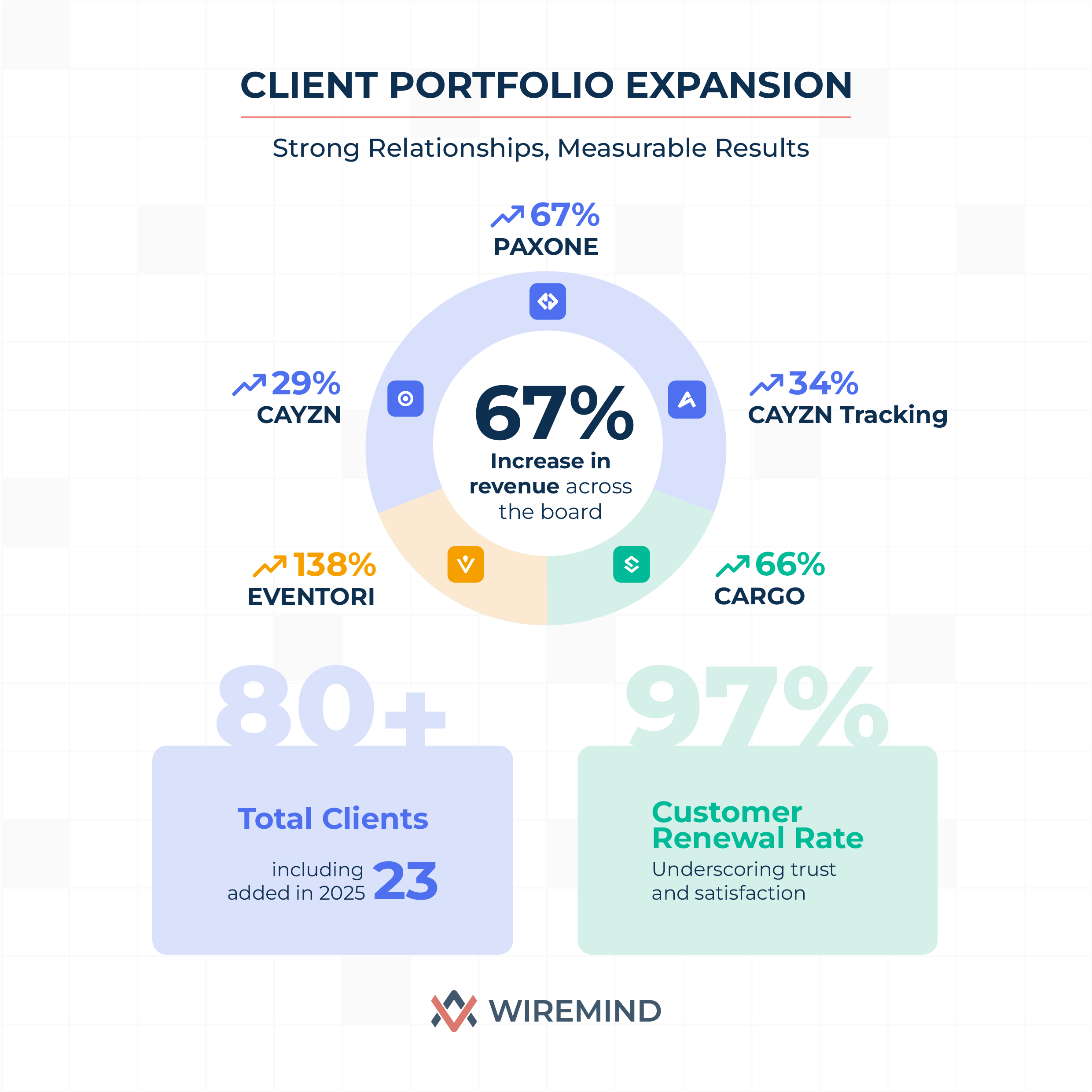
In 2025, we grew to 80+ clients, added 23 new customers, and delivered +67% revenue growth across the board. Our renewal rate reached 97% - one of the most meaningful numbers we track, because renewals don’t come from promise; they come from outcomes.
Across our portfolio, momentum was broad-based:
- CAYZN grew 29% year over year (YoY), adding new customers including Nederlandse Spoorwegen (NS), National Express, VIA Rail Canada, and Transavia Holland (HV), while renewing with long-term partners such as BlaBlaCar, OUIGO, and Itabus. The National Express partnership also marked a strategic milestone: Wiremind’s first move into the UK bus market, deploying both CAYZN and CAYZN Tracking to strengthen revenue optimization and competitive intelligence.
- CAYZN Tracking grew 34% YoY, supported by new wins and renewals, including VR-Group, SBB, BlaBlaCar, First Group, Eurostar, WESTbahn, and National Express.
- PAXONE grew 67% YoY, highlighted by a national milestone: DGITM selected PAXONE to power France’s new national rail distribution and inventory system (GITE) - a single-instance, multi-operator platform designed to unify inventory and ticket distribution across TET lines.
- EVENTORI delivered its strongest year yet with 138% YoY growth, 13 new customers (+120% vs. 2024), including our first Ligue 1 client, Angers SCO, as well as Élan Chalon and Nanterre 92, among others. We also renewed our partnership with Paris Saint-Germain Football Club (PSG) - further strengthening EVENTORI’s footprint in modern ticketing and revenue management.
- CARGOSTACK and SKYPALLET grew 66% YoY, adding five new clients and continuing to prove value in environments where decisions must be fast, constraint-aware, and resilient.
Scaling Talent & Culture With Intention
Growth is never only commercial. It’s organizational - and it’s cultural.
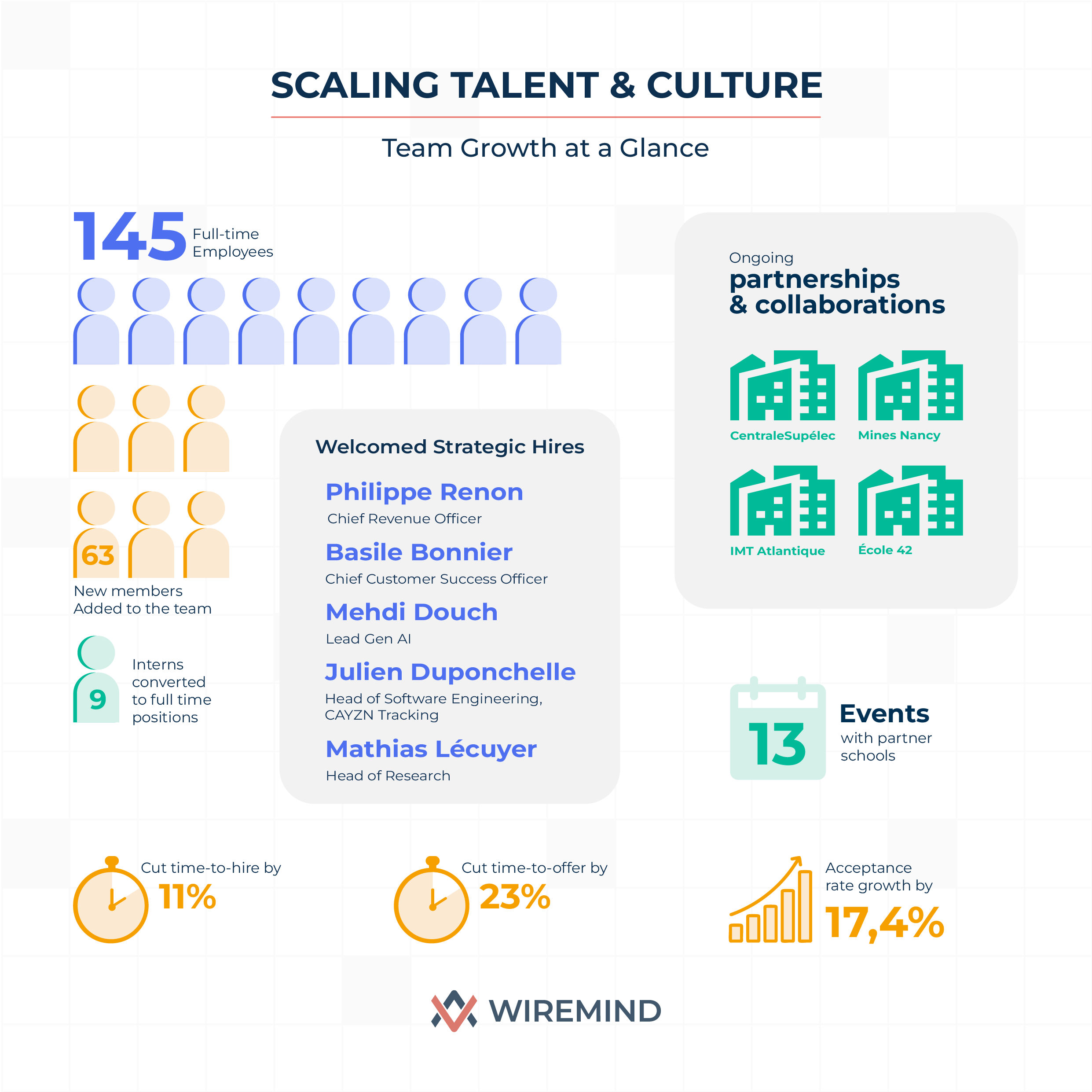
We closed the year at 145 employees, welcomed 63 new team members, and converted nine interns into full-time roles. We also made hiring faster and more consistent: time-to-offer dropped by 23%, time-to-hire by 11%, and our acceptance rate increased by 17.4%. That combination matters: faster processes, stronger alignment, and a better candidate experience - without lowering the bar.
2025 also brought strategic hires that strengthened execution across revenue, customer success, engineering, and AI: Philippe Renon (Chief Revenue Officer), Basile Bonnier (Chief Customer Success Officer), Mehdi Douch (Lead Gen AI), and Julien Duponchelle (Head of Software Engineering, CAYZN Tracking).
Beyond hiring, we kept investing in the ecosystems that shape future talent. Our partnerships with CentraleSupélec, Mines Nancy, IMT Atlantique, and École 42 continued throughout the year, with 13 events run with partnered schools - because sustained innovation is built not only in product roadmaps, but also in communities.
Product Highlights: What We Improved (And Why It Mattered)
In 2025, our product philosophy wasn’t about shipping “more.” It was about making our products clearer, more controllable, and more reliable at scale - so day-to-day decisions feel simpler, faster, and safer for the teams running complex operations.
CAYZN: Customization, Control, And Visibility At Scale
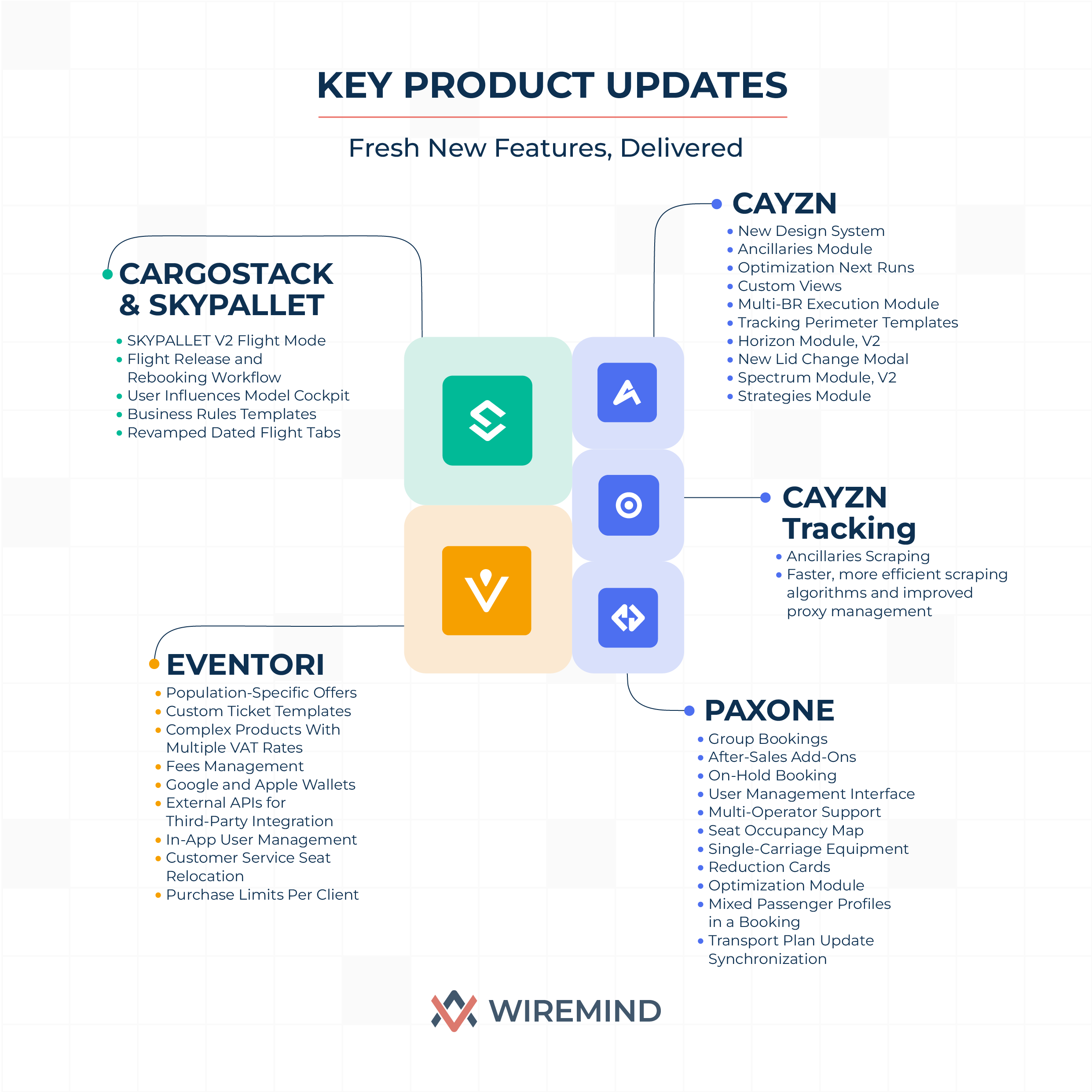
In CAYZN, we strengthened the core experience and removed friction from high-impact workflows. The rollout of a New Design System created a more consistent UI foundation - improving readability and overall experience for users while accelerating delivery for product teams. We expanded commercial control with the Ancillaries Module, and reinforced decision confidence through upgrades like the Next Optimization Runs for the AI Module (increased visibility into upcoming changes of the Optimizer), Custom Views (user-level personalization across key views in the RM Module), and Multi-BR Execution paired with Tracking Perimeter Templates (more consistency, less duplication, easier maintenance).
On the analytics side, Horizon V2 strengthened CAYZN’s BI layer to give teams a more macro, 360-degree view of revenue management with improvements such as drill-downs, live counters, and tighter alignment with RM workflows. Alongside this, we introduced several further product improvements: a redesigned Lid Change Modal, Spectrum upgrades, and one-click AI Strategies, all aimed at making critical actions more intuitive.
The scale behind CAYZN tells the same story:
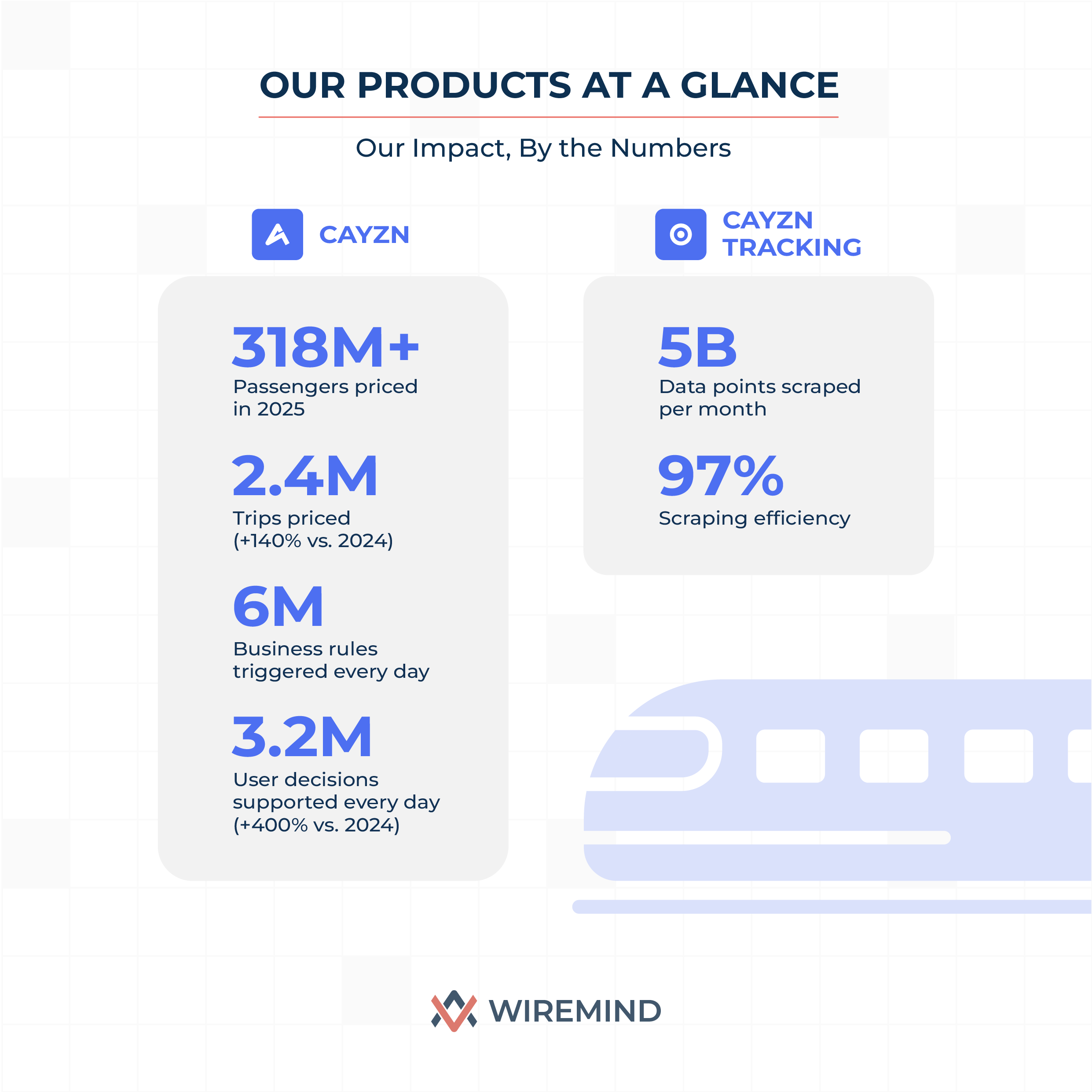
- 318M+ passengers priced in 2025
- 2.4M trips priced (+140% vs. 2024)
- 6M business rules triggered every day
- 3.2M user decisions supported every day (+400% vs. 2024)
CAYZN Tracking: Increased Scope, Better Results
For CAYZN Tracking, the priority was reliability at scale - making competitive intelligence broader and more dependable. We introduced Ancillaries Scraping, improved scraping efficiency, and strengthened proxy management to increase resilience and consistency. The result was performance teams can build decisions on: 5B data points scraped per month on average, with 97% scraping efficiency.
PAXONE: Deeper Operational Workflows, Easier Control
In PAXONE, 2025 was about adding depth where it matters most: the workflows that keep inventory, distribution, and customer operations moving. We expanded booking capabilities with Group Bookings, On-hold Bookings, and support for mixing multiple passenger profiles in a single booking, while strengthening post-purchase operations with After-sale Ancillaries. We improved autonomy through an in-app User Management Interface, and made complex environments easier to run with multi-operator support within a single instance - enabling distinct configurations and access controls without multiplying infrastructure.
On the operational side, we upgraded seat and equipment handling with a Seat Occupancy Map and Single-Carriage Equipment configurations, and strengthened the integration story with the PAXONE OSDM Sandbox - a practical step toward industry-wide standardization, lowering barriers to integration and accelerating adoption.
EVENTORI: Smoother Fan Journeys, Stronger Operational Tooling
EVENTORI’s product progress in 2025 focused on two things: making the fan experience smoother, and giving operators stronger tools behind the scenes. We launched a redesigned B2C Front-Office to improve browsing, seat selection, and checkout. We expanded distribution and on-site experience with Google & Apple Wallet integration, and added flexibility through Custom Ticket Templates, Fees Management, Eligibility-based Offers, and External APIs designed for third-party integrations.
The impact showed up clearly in outcomes:
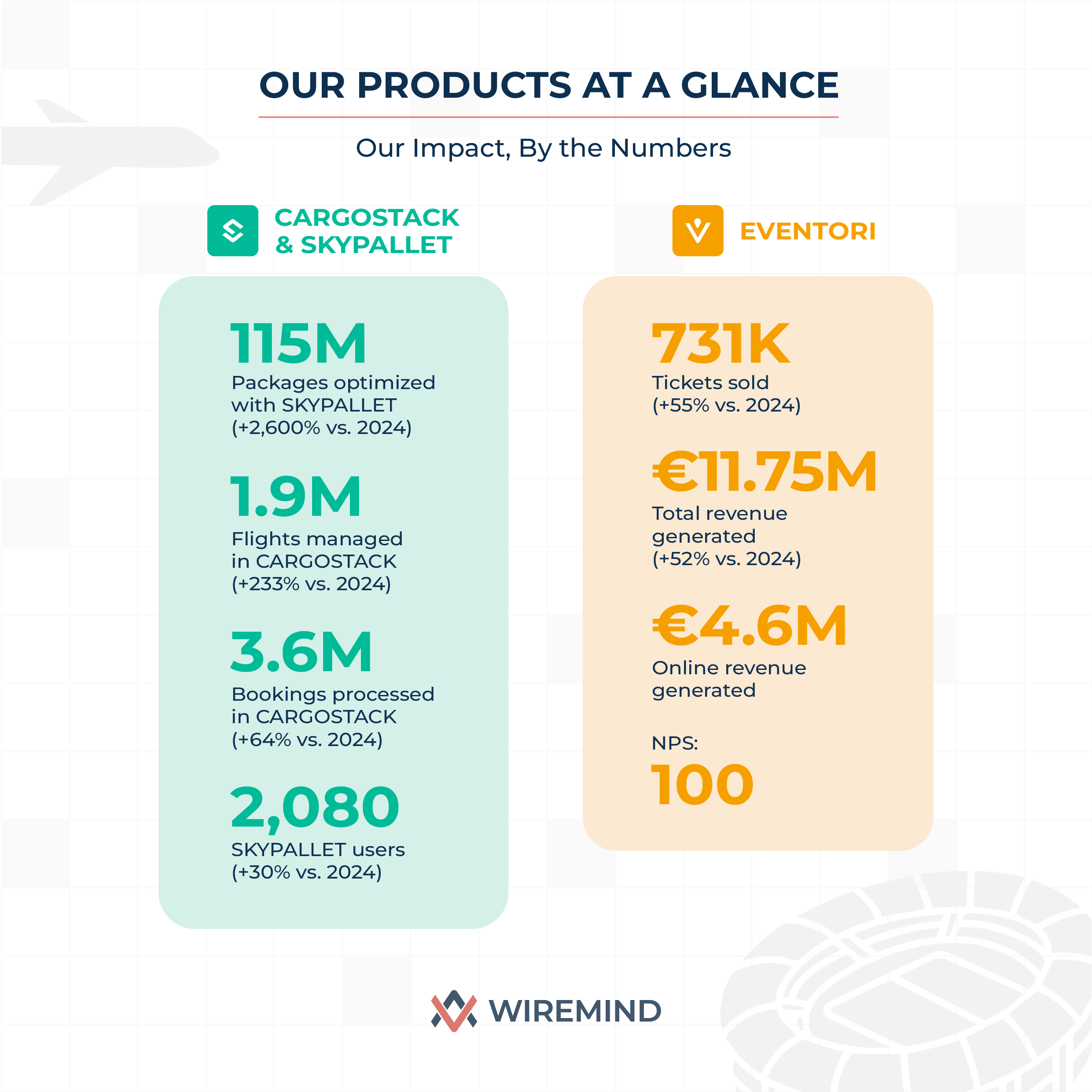
- 731K tickets sold (+55% vs. 2024)
- €11.75M total revenue generated (+52% vs. 2024)
- NPS of 100
CARGOSTACK & SKYPALLET: Optimization Grounded In Real Operations
In Cargo, our focus was to bring optimization closer to operational reality - more flight-centric, more resilient during disruption, and more steerable by users. SKYPALLET V2 Flight Mode introduced flight-level planning workflows with clearer constraint handling and stronger decision autonomy. A dedicated Flight Release & Rebooking workflow reduced recovery friction when plans change.
The scale accelerated sharply:
- 115M packages optimized (+2,600% vs. 2024)
- 1.9M flights managed (+233%)
- 3.6M bookings processed (+64%)
- 2,080 SKYPALLET users (+30%)
Engineering & Security At Scale
Behind every Wiremind product feature is an engine built for speed, scale, and security:
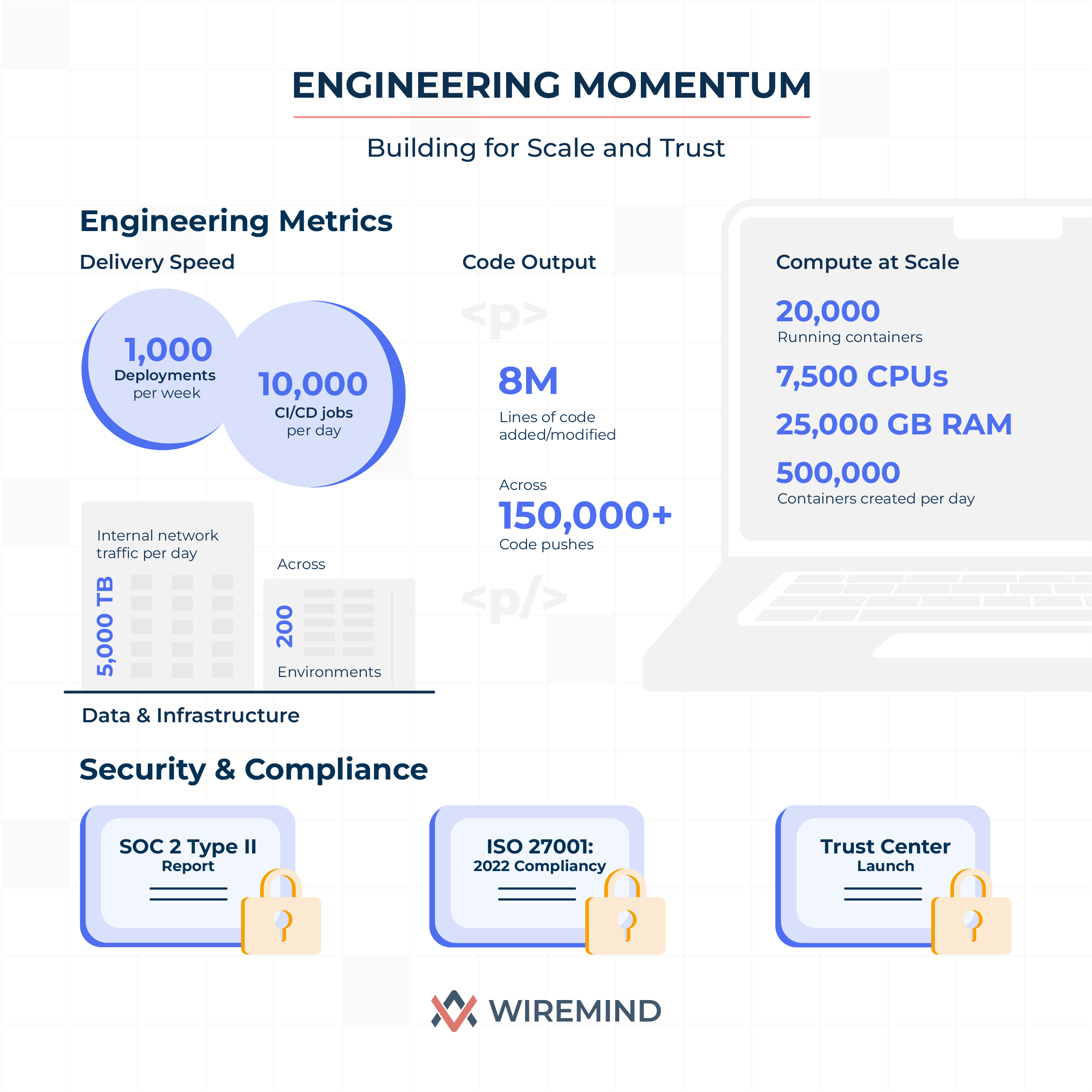
- Engineering output: 8M lines of code added/modified across 150,000+ code pushes
- Compute at scale: 20,000 running containers, 7,500 CPUs, 25,000 GB RAM, and 500,000 containers created per day
- Delivery speed: 10,000 CI/CD jobs per day and 1,000 deployments per week
- Infrastructure throughput: 5,000 TB of internal network traffic per day across 200 environments
- Security & compliance: ISO 27001:2022 compliancy, SOC 2 Type II report, and Trust Center launch - reinforcing a trust-by-design mindset
CAYZN AI: Smarter Forecasts, Faster Optimization, Clearer Decisions
In 2025, we made major progress on forecasting and optimization in CAYZN. After several years of R&D, we deployed a next-generation ML architecture based on TS Mixer neural networks, improving forecast accuracy and enabling more precise elasticity modeling. We also enabled progressive model deployment, allowing new ML models to roll out route by route for smoother releases, controlled experimentation, and faster value delivery.
On the revenue side, we advanced overbooking optimization, combining predictive no-show models with risk-based strategies.
On the AI side, the impact is concrete:
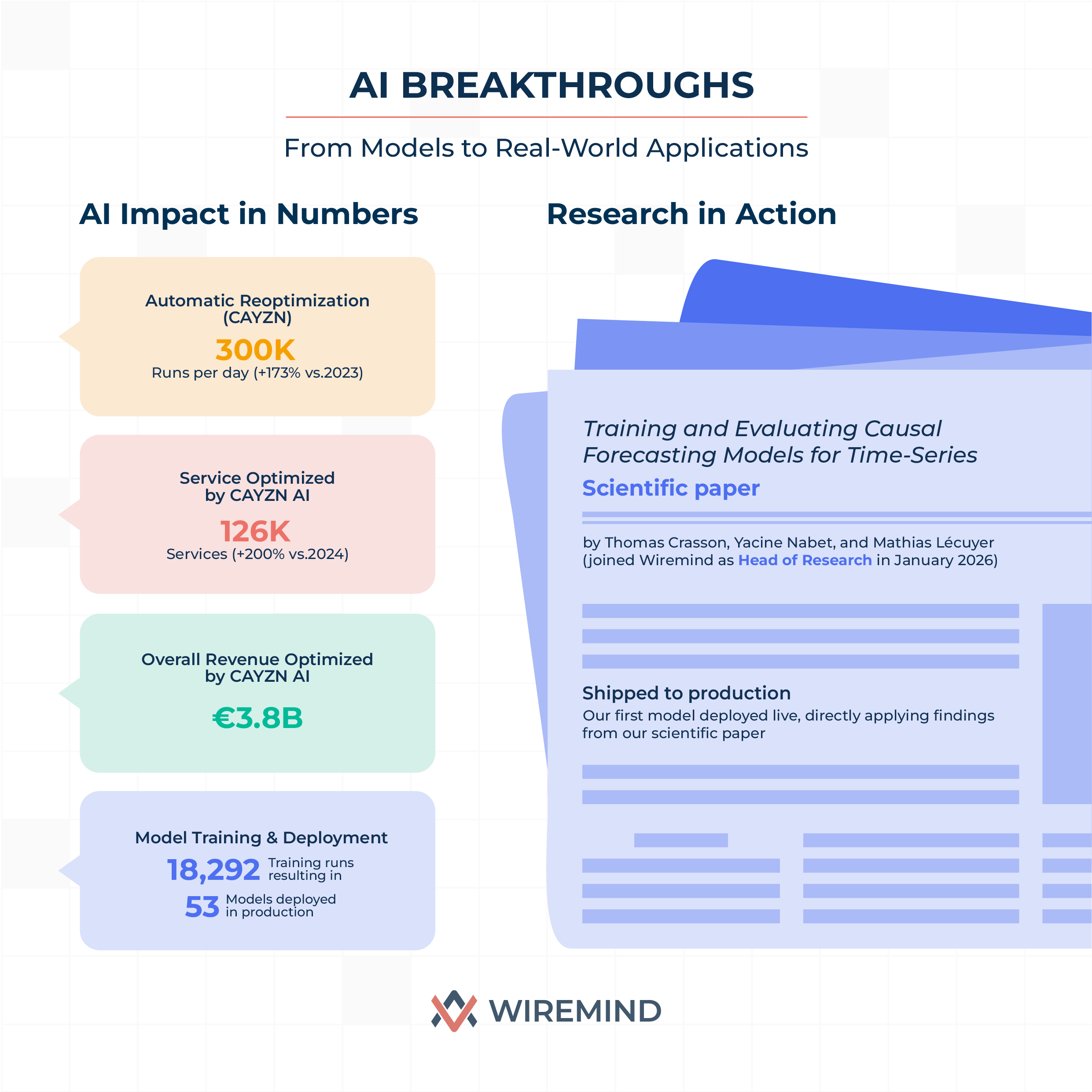
- Automatic Reoptimization (CAYZN): 300K runs per day (+173% vs. 2023)
- Services Optimized by CAYZN AI: 126K services (+200% vs. 2024)
- Overall Revenue Optimized by CAYZN AI: €3.8B
- Model Training & Deployment: 18,292 trainings run, resulting in 53 models deployed in production
Finally, we strengthened the bridge between research and production. Our scientific paper - Training and Evaluating Causal Forecasting Models for Time-Series - didn’t stay theoretical: it directly contributed to our first model deployed live in production, applying published findings. We’re carrying that momentum into 2026 with Mathias Lécuyer joining Wiremind as Head of Research in January 2026.
Community Moments: Strengthening Connections Worldwide
Progress thrives on conversation, and 2025 was a year of showing up - to share, listen, and pressure-test ideas with the people who operate complex systems every day.
Global Industry Presence
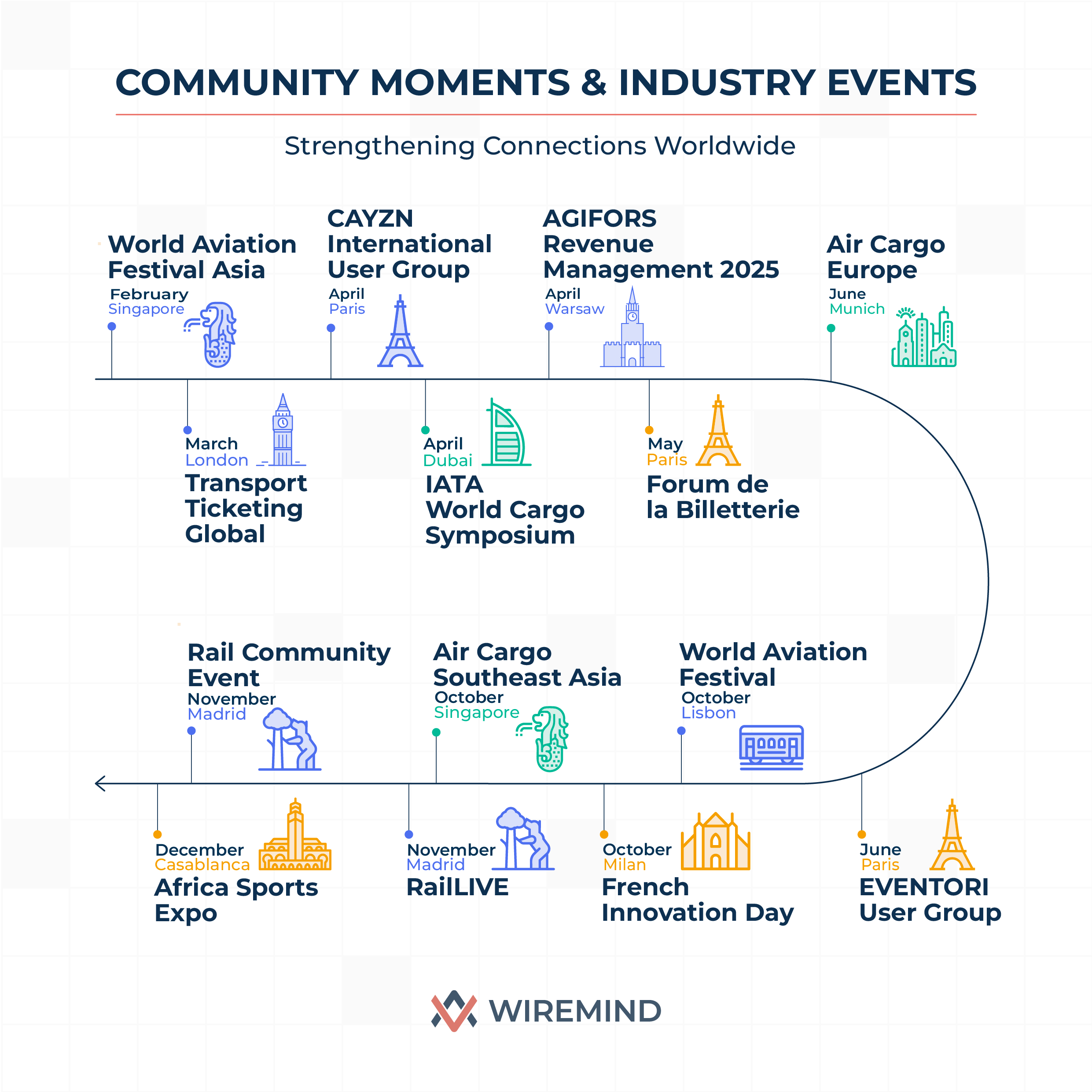
Across Passenger, Entertainment, and Cargo, our teams met partners and peers at key industry gatherings. Highlights included Forum de la Billetterie (Paris), where Hugo Messicat (Head of Product, EVENTORI) joined a roundtable on Revenue Management 3.0 in sports and entertainment alongside industry leaders, including Thibault Jaillet (Head of Revenue Management, Paris Saint-Germain Football Club).
At World Aviation Festival (Lisbon), we hosted a Fireside Chat with Eric Tanner (Former CCO, Flair Airlines) and our CRO, Philippe Renon, to share learnings from our partnership.
In rail, RailLIVE & Rail Community (Madrid) was a strong moment for Passenger Product Suite: two speaking sessions - with Rémi Habfast (General Manager, PAXONE) on schedule optimization and Charles Pierre (Co-founder and CTO at Wiremind) on GenAI in revenue management - followed by our first dedicated Rail Community networking evening, bringing together 35+ professionals from 10 companies.
Across the year, we also connected with the ecosystem at Aviation Festival Asia (Singapore), Transport Ticketing Global (London), IATA World Cargo Symposium (Dubai), AGIFORS Revenue Management (Warsaw), Air Cargo Europe (Munich), French Innovation Day (Milan), Air Cargo Southeast Asia (Singapore), and Africa Sports Expo (Casablanca).
User Groups: CAYZN & EVENTORI
Direct feedback is what keeps our roadmap practical and targeted towards our users. Hence this year, we hosted two major user-focused events to hear directly from our customers.
For EVENTORI, we welcomed customers to our Paris offices for an in-person community session centered on innovation in sports ticketing, followed by a community webinar later in the year covering new capabilities such as B2B Billing, Hybrid VAT bundles, and a case study on population-based offers with Angers SCO (Ligue 1 football club).
For CAYZN, we hosted our first International User Group in April. Over two days in Paris, we welcomed 80+ participants from 13 customer companies (including BlaBlaCar, DSB, Eurostar, Flair Airlines, Itabus, Le Train, Ouigo, SJ, SNCF, TER, Transavia, Trenitalia, and VR) for hands-on deep dives, GenAI workshops, and co-creation sessions spanning feature evolution, innovation, product development, AI, and UX & configuration.
Sharing The Craft: Industry Stories And Product Heritage
We also launched two major content initiatives to share more about the industry through our customers and also to shed a light on where our products are originating from.
With EVENTORI, we launched the industry’s first “A Day in the Life of” series - shifting the lens from software to the people behind ticketing, and going behind the scenes of sports club operations to show how teams navigate real complexity and drive efficiency using EVENTORI.
In parallel, we celebrated 10 Years of CAYZN, looking back on a decade of revenue management innovation, key milestones, and the product journey that shaped where we are today - including an interview with our CEO, Colin Girault-Matz.
Closing The Year: What Comes Next
The scorecard for 2025 reads like this: more clients, more product depth, more platform scale, and stronger trust foundations. But the real story is the flywheel effect: bigger teams build better features; better features attract bigger partners; bigger partners push our platforms into new operational realities - which then fund deeper R&D and a stronger baseline for what’s next.
As we head into 2026, the focus remains the same: building products that help teams make better decisions in complex environments - across passenger transportation, cargo logistics, and live entertainment.
%20(2).png)
%20(13).png)


